

What to expect on your cochlear implant journey, from your first appointment to life with your implant.
The Patient Journey
Your cochlear implant journey, step by step
Everyone’s journey is a little different, but most adults follow the same five steps. Our team will guide you through each one and explain what comes next. Bone conduction implants follow a similar path, with the option to trial a device before surgery.
01
Hearing Assessment
Your first appointment is with one of our implant audiologists and usually takes about 90 minutes. We will:
- ask about your hearing, health and everyday listening challenges
- test your hearing, and how well you understand speech with your hearing aids
- talk about what a cochlear implant can and can’t do
- explain costs and funding options
If an implant may help, we’ll refer you to one of our ENT surgeons. Your GP can refer you for this assessment, or you can contact us to ask about booking.
If you are determined to be a candidate, you will then be referred for a review with a specialist ENT.
02
Seeing your ENT surgeon
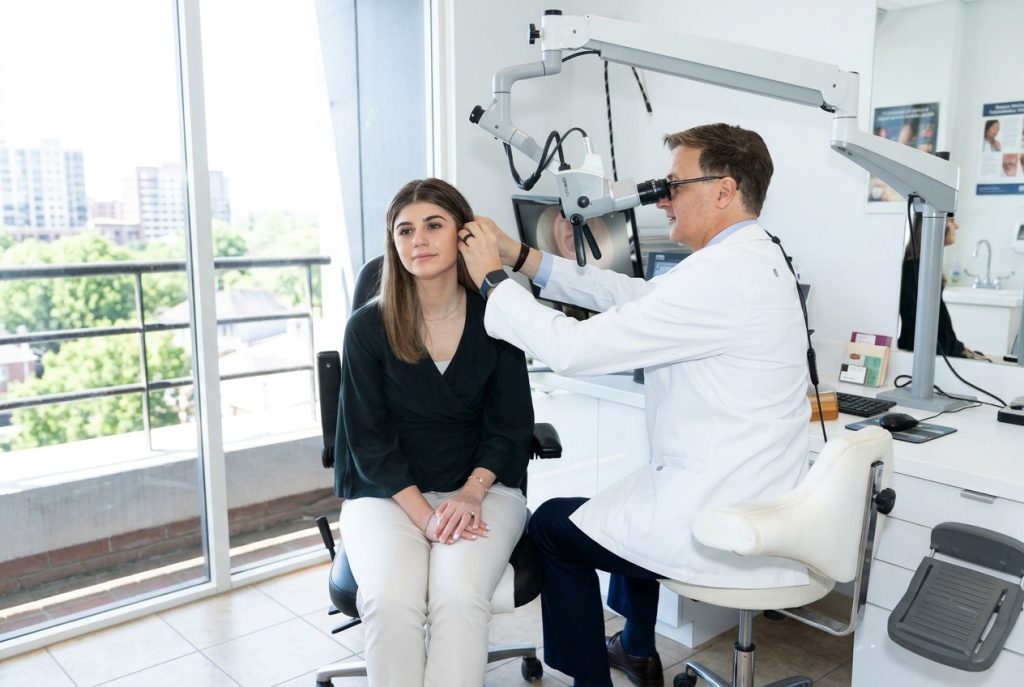
Next, you’ll see an ENT surgeon who performs cochlear implant surgery. They will:
- check your ears and review your medical history
- arrange scans, usually a CT and/or MRI, to look at your inner ear
- explain the operation, its risks and the recovery
- talk through the costs
You’re welcome to bring a family member, and there’s no pressure to decide on the day.
03
Surgery
Cochlear implant surgery is done under general anaesthetic and usually takes 1 to 3 hours. Most people go home the next day.
The surgeon places the implant under the skin behind your ear and gently inserts a thin electrode into the cochlea. The implant is tested before you wake up. Most people return to light activities within about 1-2 weeks.
04
Switch-On
Within a week of surgery, or even the next day, your sound processor will be fitted and switched on.
Sound may seem strange or robotic at first. This is normal. Your brain needs time and practice to get used to the new signal.
In the first year, you’ll have regular appointments to fine-tune your processor. This is called mapping. You’ll also do listening practice to help your brain adjust
05
Ongoing Care
After the first year, you’ll usually see us once or twice a year. At these visits we:
- check your hearing and how you’re going with your implant
- fine-tune your processor
- review your hearing aid in the other ear, if you have one
- talk about upgrades, accessories and spare parts
Between appointments, we can also help by phone, telehealth or Remote Assist. This can save you a trip to the clinic.
Have a question about any step? Our team is happy to talk you through it.
Get in touch
Whether you’re a patient, GP or health professional, our team is here to help. Contact us to make a referral, ask about hearing implants, or learn more about our services.
Referring a patient? Send referrals by email to [email protected]. Please include recent audiology results where available.
-
Mon - Fri: 9am - 5pm
Send us a message
Please complete the form to submit an enquiry.

